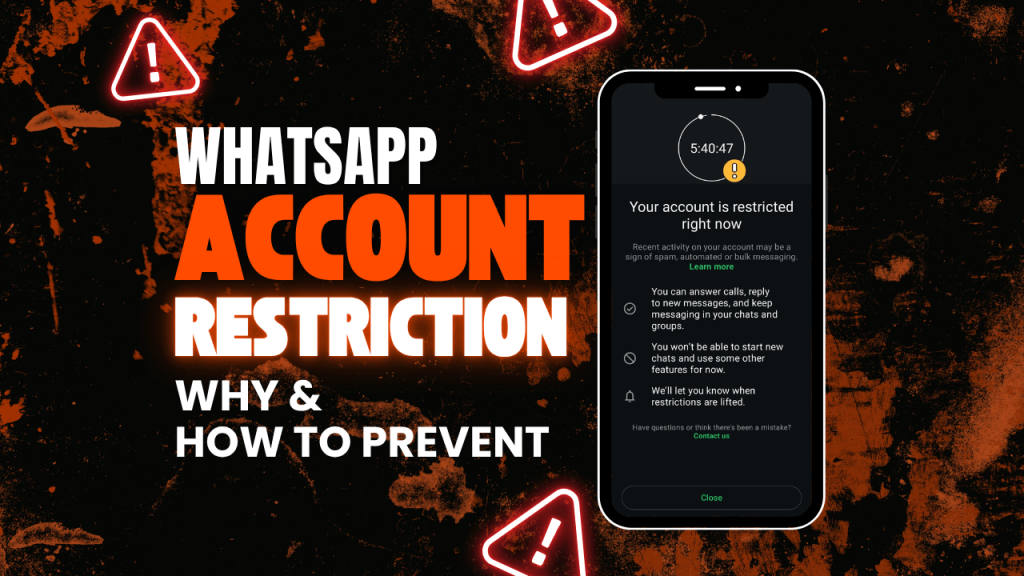
If you’re seeing the message “Your account is restricted right now”, something in your messaging behaviour has already crossed WhatsApp’s internal threshold.
Most people search for “WhatsApp banned” when this happens. But what they’re actually experiencing first is a restriction.
It’s an early warning. And if the pattern continues, it usually leads to a ban.
Quick answer
A WhatsApp account gets restricted when recent messaging activity starts to look like spam or bulk outreach based on how recipients respond. You can still reply to existing contacts, but you won’t be able to start new conversations for a period of time. Restrictions usually last a few hours, but repeated patterns can lead to a full ban.
What a restriction actually means
When your WhatsApp account is restricted, it doesn’t mean everything stops working immediately.
You can still reply to people you’ve already chatted with. But you won’t be able to start new conversations, message new contacts, or add people into groups.
In most cases, the restriction lasts around 6 hours.
But we’ve also seen cases where it stretches closer to 24 hours, especially when similar behaviour keeps repeating.
There’s nothing you can manually do to remove it. It simply expires after a set period, and WhatsApp notifies you when it’s lifted.
If the same patterns continue after that, the next step is usually a ban.
Why WhatsApp account gets restricted
Most explanations stop at “don’t spam” or “don’t send too many messages”.
That’s not wrong, but it’s not useful either.
From what we’ve seen, WhatsApp doesn’t just look at how many messages you send.
It looks at how people react to them.
If you send messages and a percentage of recipients ignore, block, or report you, that creates a negative signal. Once that signal crosses a certain threshold, restrictions start to happen.
No one knows the exact number. WhatsApp doesn’t disclose it, and that’s intentional.
Why this happens even for legitimate businesses
You might be reaching out to real leads. You might have a proper offer. You might not feel like you’re spamming at all.
But from WhatsApp’s perspective, it’s not about your intention. It’s about whether the person receiving your message expected it.
If someone doesn’t remember you, or your message feels out of context, they are more likely to ignore or report it. And once this happens across enough conversations, your account starts getting flagged.
We saw this happening to Club Pilates Singapore, where staff only contacted leads when they had free time.
We’ve also seen this come from:
- following up too late after the initial interaction
- sending the same message to many people without variation
- reaching out without clear opt-in
- starting conversations outside of an active chat context
Why most “prevention tips” don’t work
A lot of advice focuses on small changes.
- Send fewer messages.
- Change your copy.
- Avoid certain words.
In reality, these don’t fix the core issue.
Because the problem is not the message itself.
If the way you initiate conversations and send messages doesn’t align with how WhatsApp expects businesses to operate, restrictions will keep happening.
A simpler way to prevent WhatsApp restrictions
The biggest shift is not what you say. It’s how the message is sent.
WhatsApp separates normal chatting from outbound messaging.
If you’re replying within an ongoing conversation, you can send messages freely.
But if you’re starting a conversation, especially at scale, WhatsApp expects you to follow a different structure.
The simplest way to think about it: If you’re reaching out to people, you should be using pre-approved message formats, not random free-form messages.
These are what WhatsApp calls templates. They are simply messages that WhatsApp has already approved for business outreach.
Even if you send messages in volume, it doesn’t trigger the same risk patterns as sending unstructured messages randomly.
If you’re facing repeated restrictions
A one-time restriction is usually just a warning.
But if it keeps happening, it means your current setup is already working against you.
At that point, being more careful won’t solve it. The structure needs to change.
We’ve been working with WhatsApp marketing since 2018, and we’ve seen how easy it is for accounts to get restricted or banned when things are not set up properly.
That’s also why this became a core focus in how we build our system.
What this looks like in practice
We’ve had a client send over 100,000+ messages using a single WhatsApp number, without going through the usual cycle of restrictions and bans.
Not because they reduced volume.
Not because they changed their copy.
But because the system was structured correctly from the start:
- how conversations were initiated
- how messages were sent
- how WhatsApp expects outbound messaging to behave
Once that’s in place, scaling becomes much more stable.
Conclusion
If your WhatsApp account is restricted, it’s a signal that your messaging setup is starting to trigger the wrong patterns.
You can wait for the restriction to lift. But if nothing changes, it will likely happen again.
If you’re dealing with repeated restrictions, or trying to scale WhatsApp outreach without risking your number, this is something we can help you structure properly.
👉 Reach out to us and we can walk through your current setup and show you what’s causing the issue.