Many Singapore SMEs lose potential customers not because they cannot fulfil the enquiry, but because they reply too late.
A lead sends a WhatsApp message, Instagram DM, Facebook enquiry, or website chat message. The team is busy, it is after office hours, or the enquiry needs someone to check internally. By the time someone replies, the lead may have already messaged another vendor.
This is where AI chatbots and AI sales agents can make a real difference for SMEs in Singapore.
But there is also a valid concern.
- What if the AI chatbot gives the wrong answer?
- What if it promises something the business cannot deliver?
- What if it makes up information just to sound helpful?
For businesses, this concern is completely understandable. A fast reply is useful only if the response is accurate. If an AI chatbot replies quickly but gives the wrong information, it can create confusion, damage trust, and make the sales process harder for the team.
That is why a good AI chatbot should not be designed to answer everything at all costs. It should be designed to reply quickly, answer accurately when it has the information, and know when to check with the team when it does not.
Leads Do Not Always Need Instant Answers
Most businesses assume customers want instant answers. But in many real sales conversations, what leads want first is instant reassurance.
They want to know that their message has been received. They want to feel that someone is handling their request. They want confidence that the business is responsive and reliable.
This matters a lot for SMEs because many customer enquiries are not always straightforward. A lead may ask about a custom package, a specific event setup, menu options, availability, pricing, photos, or whether something can be arranged for a particular occasion.
Not every answer will be inside the chatbot’s training data. Not every answer should be guessed.
In these situations, the role of the AI chatbot is not to pretend it knows everything. Its role is to acknowledge the question, avoid giving inaccurate information, and keep the lead engaged while the team checks.
Sometimes, the best response is not an instant answer. Sometimes, the best response is simply:
“Let me check with my team and get back to you.”
Why AI Chatbots Should Not Hallucinate Answers
One of the biggest risks of using AI for customer enquiries is hallucination. This happens when the AI gives an answer that sounds confident but is not based on accurate information.
For example, if a lead asks whether a particular food station is vegetarian, the chatbot should not say “yes” unless the business has provided that information. If a lead asks for photos of a setup, the chatbot should not pretend it has photos if none were provided.
In sales, a wrong answer can create bigger problems later. It can lead to misunderstandings, disappointed customers, or extra work for the team to correct the conversation.
This is why guardrails are important.
A good AI chatbot should be trained to answer only when it has reliable information. When the information is missing, it should not make things up. Instead, it should explain that it will check with the team and follow up.
This helps the business stay fast without becoming careless.
Example 1: Handling a Custom Menu Enquiry
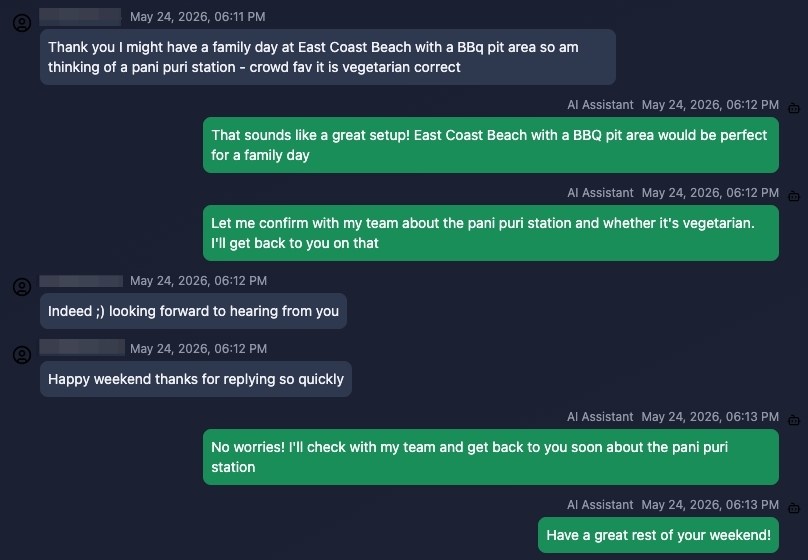
In one conversation, a lead asked our client’s AI agent whether they had a pani puri station for a family day event. The lead also wanted to know whether it was vegetarian.
At that point, the AI agent was not trained with this information. From what we knew, pani puri was not listed on the client’s standard menu, and there was no confirmed information about whether it was vegetarian.
Instead of making up an answer, the AI agent replied naturally that it would check with the team and get back to the lead.
This is important because the agent did not hallucinate. It did not overpromise. It also did not leave the lead hanging.
The lead was perfectly fine with waiting because they received a prompt reply and knew someone was helping them.
That is a big win in a sales conversation.
The lead did not feel ignored. They did not need to immediately look for another vendor. They had reassurance that the business was responsive and that their request was being handled.
Example 2: Answering What It Knows and Escalating What It Does Not
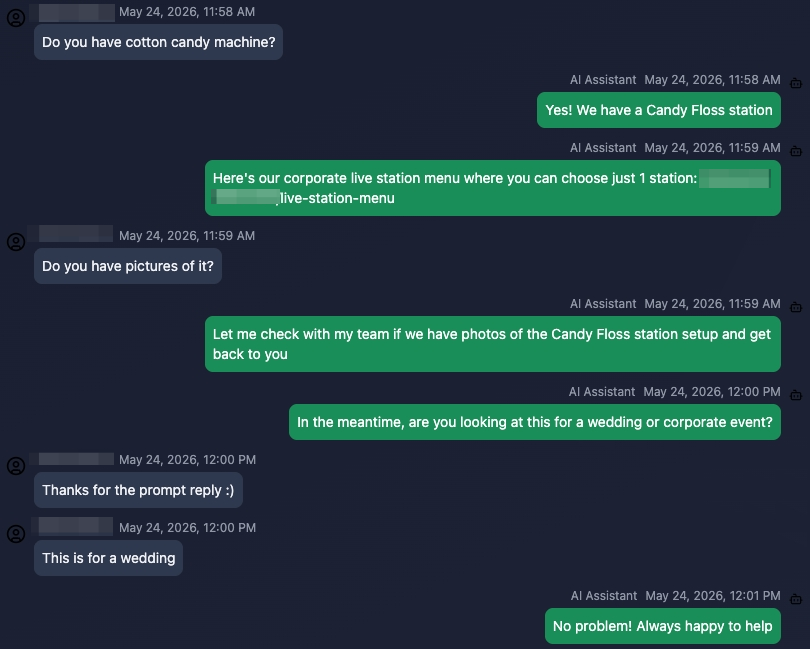
In another conversation, a lead asked whether our client had a cotton candy machine. The AI agent was trained with the client’s live station menu, so it was able to answer accurately that they had a Candy Floss station. It also shared the relevant menu link with the lead.
That part was straightforward because the AI had the correct information.
But the lead then asked whether there were pictures of the Candy Floss station setup. In this case, the AI agent was not trained with actual photos of the setup.
Instead of sending a random image, making up an answer, or claiming that photos were available, the AI agent replied that it would check with the team and get back to the lead.
At the same time, it continued the conversation by asking whether the lead was looking at this for a wedding or corporate event.
This is what a good AI sales assistant should do. It answered what it knew, avoided faking what it did not know, gave a clear next step, and continued qualifying the lead while waiting for the team.
Why “Let Me Check” Is Better Than Silence
Some businesses worry that saying “let me check” makes them look slow or unprepared.
But in reality, “let me check” is often much better than silence. It is also much better than giving a wrong answer.
When a lead receives a prompt reply, they know that the business has seen their message. They feel acknowledged. They are more likely to wait because someone has taken ownership of the request.
This is especially important for enquiries that come in after office hours, during weekends, or when the team is busy with operations.
For many Singapore SMEs, enquiries do not only come in during working hours. Customers may message at night, on Sundays, or during public holidays. Without an AI chatbot, these messages may sit unanswered until someone is available.
By then, the lead may already be speaking to a competitor.
An AI chatbot helps prevent that by giving an immediate response, even if the final answer still needs to come from the team.
How AI Chatbots Help SMEs Capture More Leads
The value of an AI chatbot is not just in answering frequently asked questions. It also helps businesses capture and qualify leads more consistently.
A well-designed AI chatbot can ask follow-up questions, understand what the lead is looking for, collect important details, and route the enquiry to the team when needed.
For example, instead of simply saying “we will get back to you,” the chatbot can continue the conversation by asking whether the enquiry is for a wedding, corporate event, family day, birthday party, or another occasion.
This keeps the lead engaged and gives the sales team more context when they take over.
For SMEs, this means fewer missed enquiries, faster response times, and better lead quality.
It also means the team does not have to manually reply to every repetitive question, while still staying involved when a human answer is needed.
Fast Replies Should Still Build Trust
Speed is important in sales, but speed alone is not enough.
A fast reply that gives the wrong information can hurt trust. A slower reply with no acknowledgement can cause the lead to move on. The ideal response is fast, honest, and helpful.
This is where AI chatbots can support SMEs well.
They can reply instantly without pretending to know everything. They can reassure leads without overpromising. They can answer common questions accurately and escalate uncertain questions to the team.
A good AI chatbot does not try to sound smart. It helps the business build trust.
It knows when to answer. It knows when to ask a follow-up question. It knows when to say it will check with the team.
And most importantly, it makes sure the lead does not feel ignored.
Final Thoughts
For Singapore SMEs, replying to customer enquiries quickly can make a big difference in lead conversion. But the goal is not just to reply fast. The goal is to reply fast without giving wrong answers.
That is why the best AI chatbots are not the ones that try to answer everything. The best AI chatbots are the ones that know their limits.
When they have the information, they answer.
When they do not, they acknowledge the lead, check with the team, and keep the conversation moving.
Because leads do not always need instant answers.
They want instant reassurance.